

We know–from the museums and events that celebrate old Annapolis–that the city of Annapolis has great history as an important port. However, so often, the areas outside of Annapolis are not as celebrated for their history as they should be. Plenty of history pervades the other cities around Annapolis and today, we are going to discover more about Pasadena. More specifically, Hancock’s Resolution in Pasadena, a little over thirty minutes from Annapolis. This piece of land praises its past with year-round events, tours, and more, and in turn, invites you to join in sharing its history. What you’ll find below is a condensed version of what you’ll learn when you visit, along with pictures of life from centuries ago.
As retold by volunteers at Hancock’s Resolution (dressed appropriately for their roles as men and women of the 18th/19th century), the land on which present-day Hancock’s Resolution sits was once inhabited by Indians. The land was fertile and the water (we now know as Bodkin Creek and the Patapsco River) was close enough to fish and travel in. John Smith even traveled past the area, but neither Smith nor the Native Americans would be the final owners of the property. In the early 18th century, William Hancock took over the property and when Hancock’s son, coincidentally also named William Hancock, became old enough, he took over the property. However, legal battles over the land ensued and thirty years after Hancock Sr. came to the land, a man by the name of Thomas Jennings won ownership.
The land was restored to a Hancock when Stephen Hancock Sr. purchased acreage from Jennings and finally, established a strong Hancock presence on the land. Stephen’s son, Stephen Jr., assumed the property in 1785 and built the stone house visitors travel through on tours. It was also Stephen Jr. who gave the land its name we know today: Hancock’s Resolution. In the backyard, you can barely make out the headstones for Stephen Jr. and his wife, who died at the start of the 19th century. 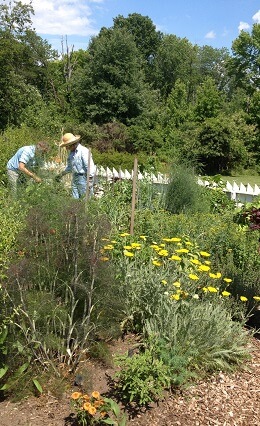
After Stephen Jr. came Francis, John, and Henry Alfred Hancock, all of whom had a piece of the Hancock property until they passed and their land was given to the next Hancock in line. The owner in the mid-1800s was Henry Alfred, who added the white building attached to the house. Fast forward from more passing of the land to 1958, when a woman, Rhoda Virginia Hancock Cook, recognized the need to preserve the family history and land. Thus, the stone house and fourteen acres were turned over to Annapolis Historic Society to preserve. In 1975, after some years of vacancy, Hancock’s Resolution found itself a place on the list of the Department of Interior’s “National Register of Historic Places.” The little house that belonged to Rhoda Virginia and her husband was moved to Hancock’s Resolution to both preserve more of the family history and to function as a caretaker’s house.
Since 1999, the property has been open for the public and thankfully restored via grants and efforts by volunteers at the Friends of Hancock’s Resolution (FOHC). Now, anyone can enjoy a peek into life on a 19th century farm. Events happen quite frequently at the farm, and because the property is for historic use, many of the events are free. Some upcoming ones to be aware of include the Father’s Day musket firing demo on June 16, the lecture about John Smith’s discovery near Hancock’s Resolution on June 23, and the patriotic activities planned on June 30. Hancock’s runs events similar to these April through October.
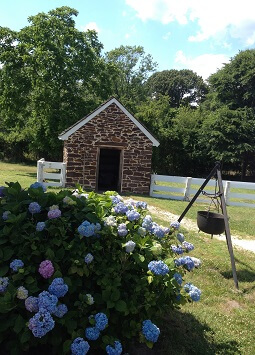 During the time of passing Hancock land from one generation to the next, there was a small building on the property that functioned as a store. This store sold lunches to watermen in the surrounding areas. The store closed in 1932 after decades of serving hungry boatmen. Inside the store now are not lunches but instead, books about the history of the farm, old pictures from the farm, tools, baskets that hold trinkets and postcards, cans of preserved goods, jars to hold water and other liquids, and a range of diverse artifacts tailored to exude the feeling of an old general store. The outside of the store is in the same dark stone pattern as the house where the Hancock family lived for generations. Around the store sits a white fence. Inside, wooden beams give character to the staged store. You’ll even find a volunteer posing as a clerk behind the counter.
Aside from the store, several other important features stand outside the family house. The garden (in a picture above), protected by a white fence today, is significant because it acts as a reminder of what life was for generations of Hancocks. As the volunteers at Hancock’s relayed, many of the Hancocks were produce farmers who sold their goods via water and later, sold them on trucks traveling to bigger cities. The Hancocks grew a multitude of crops as their income, and the garden with produce and plants acts as a symbol of what life was. Another place the Hancocks grew their produce was on the front lawn, in front of the farm house. In the spring, you can witness plowing day, where a volunteer uses a horse and mule to plow the land for better crops. During this spring plowing in mid-May, the house is open for tours.
 The garden of course yielded produce to sell, but Hancocks long ago also needed produce to sustain themselves. Some of the crops they harvested were stored in a root/vegetable cellar underneath the farm house. Indoor plumbing was never a part of the property, so with no refrigerator, the Hancocks used the coolness below the house to preserve their food. There are no veggies there now, but the stone walls, dirt floor, and stairs to climb in and out of the cellar are all original. There is one small window, but the temperature inside the cellar is much cooler than the temperature outside. A few jars are scattered about the cellar but the majority of the cellar is vacant, lending itself to an old, long-ago inhabited feeling.
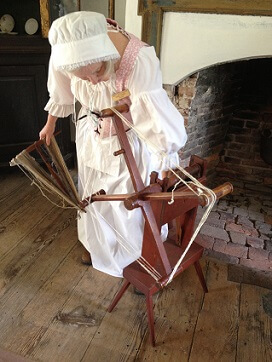 The family house, as it is one of the oldest features on the property, is perhaps the most interesting. You enter the house from near the garden, travel up two stairs, and walk through the wooden porch. Once inside, the sheer antiquity of the room becomes overwhelming, not though in an unwarranted way. The floors are wooden with original holes in them. On the left side of the room, there is a china cabinet angled to fit in the corner, which old plates, pitchers, and serving ware inside. The cabinet would have been luxurious to own at the time, and is made of solid dark wood. In the middle of one wall is a fireplace, lined with bricks and decorated with one soup pot suspended from the top. In front of the fireplace is a spool that a Hancock woman used to make clothing. Also in front of the fireplace is a quite uncomfortable rocker that held Hancock babies. To the right of the fireplace is a set of stairs that travel up to the second floor with bedrooms. Because of the old stairs and structure of the house, visitors are not permitted upstairs, but can see pictures of the bedrooms. There is also a secretary’s desk and chair and a wooden bed for the Hancock couple. Mind you, this is all in one room and there is no bathroom. The walls are white and the decorations are non-existent. The living wasn’t easy (or comfortable for that matter).
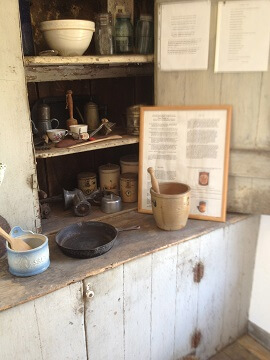 As stated in the history section from above, the white attached building was added years after the family house was built. This white building was added as a two-story kitchen. On the bottom floor sit cupboards that store skillets, jars, bowls, tea cups, and containers for sugar, flour, and the likes. Also in the kitchen is a recorded amount of the price at which produce was sold in Baltimore. On these documents, the Hancocks also recorded the commission they would receive from selling their produce to big cities like Baltimore. Here’s a spoiler alert: commission was measly.
With the fast-paced world of technology, WiFi, and business, it’s a pleasure to escape for a while to the world of years ago. Life was simple, albeit hard. Visiting Hancock’s reminds you that yes, we have made marvelous advancements (like indoor plumbing), but that we must not forget the history of the area and people around us. Take some time to visit the past at Hancock’s. Pictures are allowed, most everything is free, and the tour guides are kind and informative. Sometimes revisiting the past allows you to appreciate the present even more.
Visit www.historichancocksresolution.org to learn more about this property, see photos, and get directions.










Leave A Comment